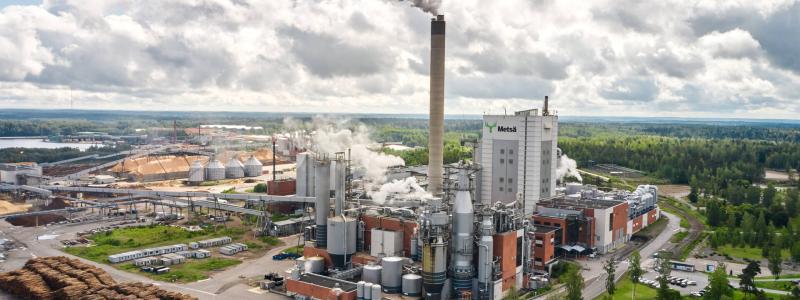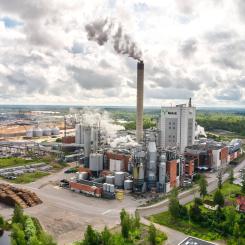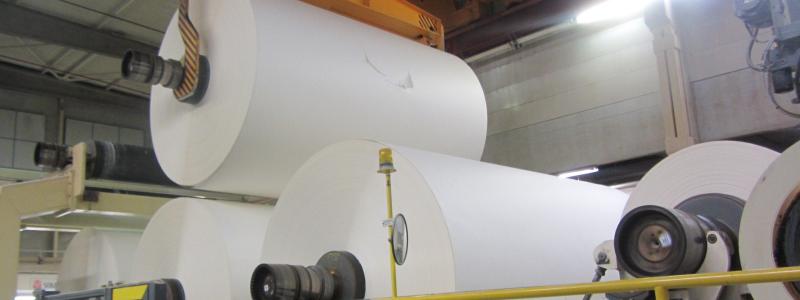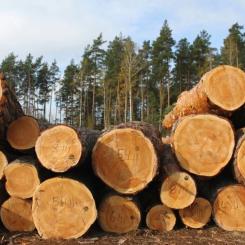

The Federal Ministry of Economics and the state of Lower Saxony have approved funding for PKV, including for planned large-scale industrial heat pumps. The goal is CO2-free production of paper and cardboard.
Like all energy-intensive companies, Papier- und Kartonfabrik Varel (PKV) is obliged to reduce its climate-damaging CO2 emissions to zero by 2045. PKV already has concrete plans for this technically and economically challenging goal. In recognition of these plans, the Federal Ministry of Economics and the state of Lower Saxony have now granted PKV funding, which relates, among other things, to the planned use of large industrial heat pumps and a high-temperature heat storage facility. The first units could be installed from 2029. As part of the Federal Industry and Climate Protection Program (BIK), the federal and state governments will jointly support up to 22% of the project volume, capped at 30 million euros, upon successful completion.
“The BIK funding competition 2025 shows that our industry is ready. Climate protection and competitiveness are not contradictory. They belong together,” said Gitta Connemann, Parliamentary State Secretary at the Federal Ministry for Economic Affairs and Energy (BMWE).
Lower Saxony’s Minister for Economic Affairs, Grant Hendrik Tonne, highlights the efforts of PKV in this regard: “Papier- und Kartonfabrik Varel has an impressive track record and has been committed to conserving resources for decades. The decarbonization project is not only an important step for the company towards a sustainable future, but also a blueprint for other paper manufacturers in Lower Saxony and beyond. It shows that we can also establish sustainable production methods in energy-intensive industries. We, as the state government, strongly support this transformation process and are pleased to be able to contribute to reducing greenhouse gases and securing jobs in the region.”
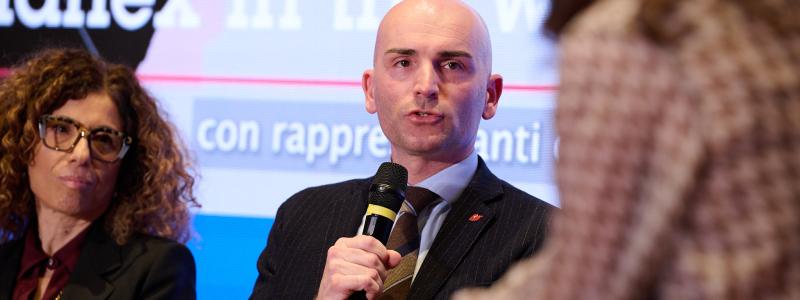
PKV shareholder Kristian Evers is also delighted with this tailwind from Berlin and Hanover: “Our efforts to achieve climate neutrality are an ecological imperative, a legal obligation, and an economic necessity all at once. We are very pleased that these special challenges are being recognized and that innovative contributions to the transformation are being supported in this way!”
However, in addition to funding, it remains important to “develop a regulatory framework that enables us to use green electricity at competitive costs – in particular, extensive exemption from grid costs (in return for which we provide grid-friendly flexibility) and sufficient quantities of green electricity,” says Evers. PKV hopes for clarity on these framework conditions soon. “We are currently moving forward with our planning despite uncertainties, because waiting is not an option either.” The use of large industrial heat pumps to increase energy efficiency is a technical innovation for the paper industry that requires special preparation and control, particularly due to the dynamic energy requirements of paper machines. At the same time, a sufficiently dimensioned power supply is a mandatory prerequisite for the use of this technology. The PKV is currently working on this as well and requires a new, high-performance power connection, for which EWE NETZ and Avacon are currently planning a branch from the 110 kV grid and a corresponding substation.