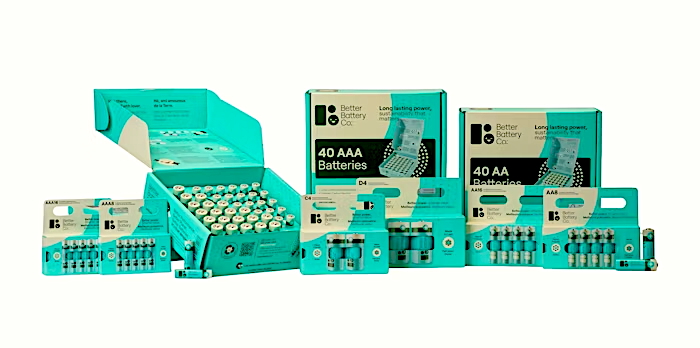




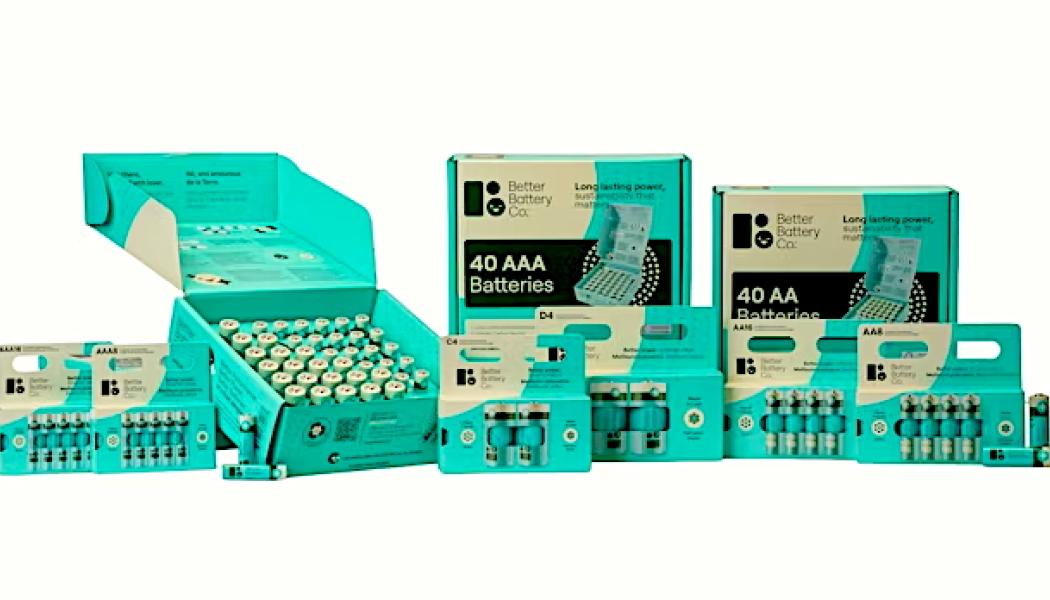
As Better Battery Co. expanded from large-format battery kits into a broader retail assortment, the company unified its redesigned packaging around a signature teal visual system aimed at improving shelf visibility, strengthening product-line consistency, and helping consumers quickly identify battery sizes and formats. Photo: Better Battery Co.
When major battery manufacturers such as Duracell and Energiser recently began replacing plastic blister packs with paper packaging, the move attracted widespread attention across the packaging industry. But a smaller Canadian company had already built its entire business model around plastic-free battery packaging years earlier.
Toronto-based Better Battery Co. is now attempting to take the next step by expanding from direct-to-consumer online sales into traditional retail distribution. To support that expansion, the company has developed packaging designed to function both as a shipping container, a household battery organiser, and a return package for battery recycling.
The company was founded in 2021 by sisters Jaclyn Byles and Jessica Jenkins with the goal of creating a more circular system for everyday household batteries, a category long dominated by disposable plastic packaging.
– Better Battery Co. was designed from the beginning to completely avoid plastic packaging, Jaclyn Byles said in the original article.
The company markets its alkaline batteries as carbon-neutral while also promoting an integrated take-back programme that allows used batteries to be returned for recycling.
Packaging became part of the business model
Unlike traditional battery packs, Better Battery’s solution was initially developed specifically for e-commerce. The packaging needed to survive shipping without additional protective plastic while also functioning as practical household storage.
The result was a lockable carton made from FSC-certified paperboard, where batteries are stored upright in separate die-cut compartments. The structure reduces the risk of battery terminals touching during transport and helps consumers keep batteries organised at home.
Inside the box, the company also created a printed “battery path” system showing consumers which battery should be used next. Once depleted, batteries can be placed back into the carton upside down, creating a visual distinction between new and used batteries.
– Customers can easily separate used batteries from new ones by reversing their orientation, Jaclyn Byles said, according to the original article.
Instructions for use, recycling, and returns are printed inside the lid. A QR code links customers directly to the company’s recycling programme, where prepaid shipping labels for depleted batteries can be ordered.
Retail expansion required a redesign
When the company entered retail chains in 2023, it became clear that the packaging also needed to perform in traditional store environments. In addition to sustainability and recyclability, the products needed a stronger shelf presence and compatibility with standard retail merchandising systems.
In 2025, the company therefore carried out a major redesign together with Toronto-based agency Juliet Creative.
The updated design centres around a dark teal colour scheme intended to create a more cohesive visual identity and improve visibility in crowded battery aisles. Typography was also redesigned to make battery sizes and pack formats easier to identify at a glance.
– We wanted the products to feel less technical and less serious than traditional battery packaging, Jaclyn Byles said in the original article.
The packaging was also adapted for bilingual English and French labelling to comply with Canadian retail regulations.
At the same time, the product range expanded. In addition to larger family kits, the company now sells smaller retail packs for AA, AAA, C, D, and 9V batteries in formats better suited to traditional retail purchases.
Pressure grows to reduce plastic waste
The packaging industry is facing increasing pressure to reduce plastic use, particularly in consumer goods categories where single-use packaging has long dominated. Batteries have become a clear example of this problem, with rigid plastic blister packs often criticised for being difficult to recycle and frustrating for consumers to open.
At the same time, the transition is not without challenges. Paper-based packaging still needs to meet safety, moisture-resistance, and durability requirements during transportation. Batteries also involve additional safety considerations related to terminal protection and fire risks.
Better Battery is attempting to position itself as an alternative to the established market leaders, but the company remains a relatively small player in a market dominated by global giants with significantly larger production capacity and retail distribution networks.
Still, the shift by larger manufacturers toward paper packaging suggests the wider battery industry is beginning to move away from plastic, a transition that could accelerate in the coming years.
Source: Packaging World.