
Deforestation in tropical regions remains a major global challenge. At the same time, representatives from the forestry sector argue that certification systems could help slow the loss of forests.
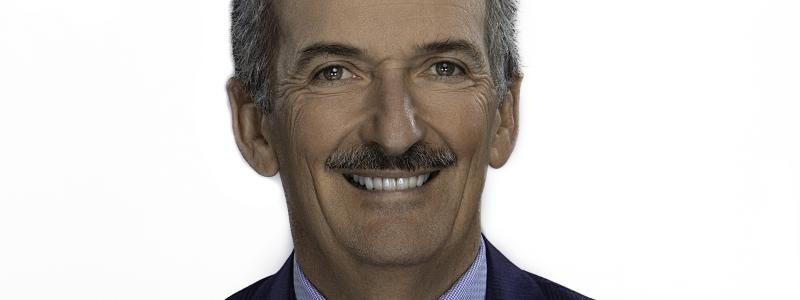
According to Janne Näräkkä, a member of the international board of the Forest Stewardship Council (FSC), certified and regulated forestry can help preserve forests even in countries where illegal logging and agricultural expansion are widespread.
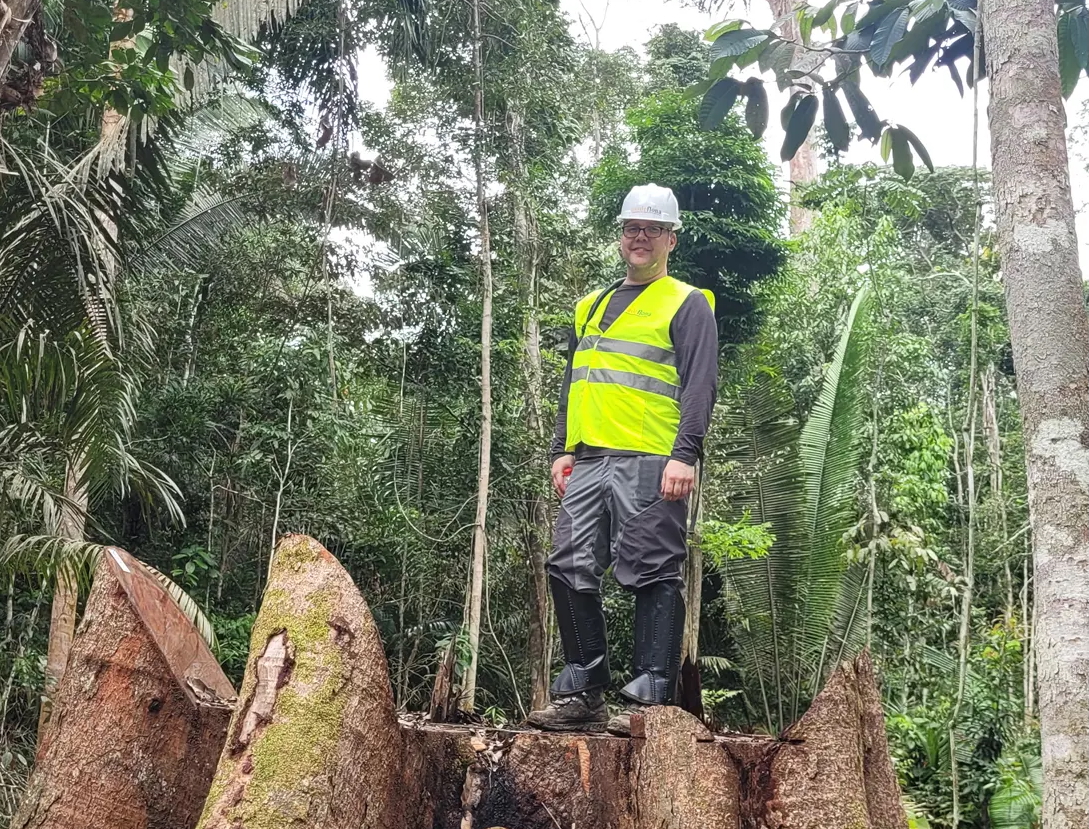
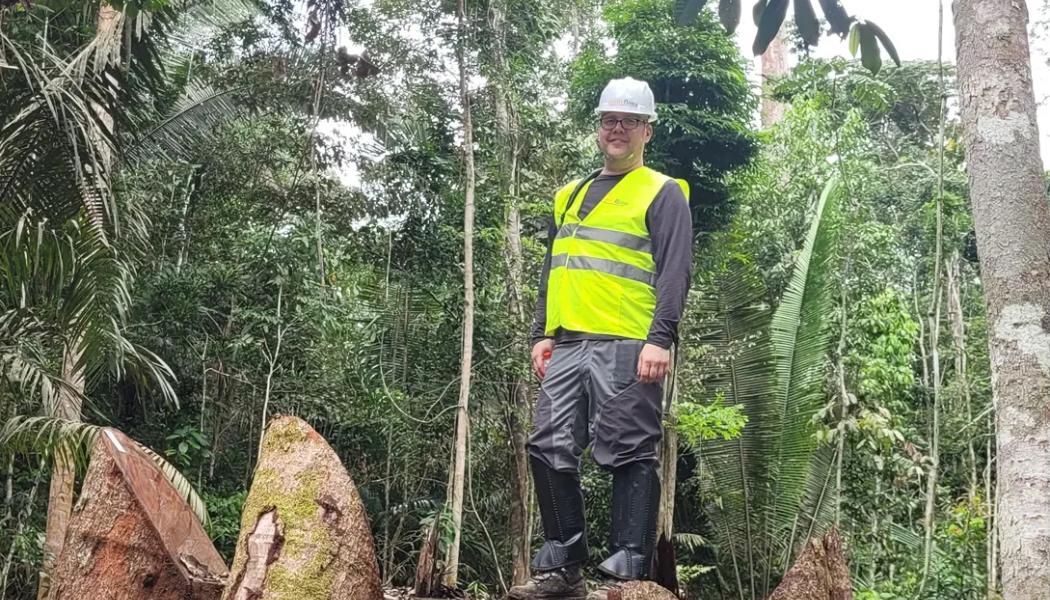
Näräkkä recently described his experiences from a visit to Brazil in an interview with the Metsä Group magazine Viesti. During the trip, he attended an international FSC board meeting in São Paulo before travelling to rainforest areas in western Brazil.
– Forestry can actually help maintain forests. If forests have no economic value, they are at risk of being converted into something else, Näräkkä said in the interview with Viesti.
Deforestation is visible across large areas
After the meeting in São Paulo, Näräkkä travelled to Porto Velho in western Brazil. From there, he continued by car through regions where large parts of the rainforest had already disappeared.
In many places, forests had been cleared to make room for cattle farming. Other areas had been converted into vast soybean fields. Long lines of trucks transported soybeans to export ports, with much of the crop destined for markets such as China.
The trip gave Näräkkä a direct view of the scale of forest loss.
– It became very clear how extensive the changes have been. After the trip, Brazilian beef has not been very appealing, and soy also raises questions, he said.
Stopping deforestation in Brazil has proven difficult. According to Näräkkä, political tools to address the issue remain limited, and in some cases, political will is lacking.
Certification can give forests economic value
One of the mechanisms used to protect forests is FSC certification, an international system for sustainable forest management developed more than 30 years ago.
In Brazil, the government often leases state-owned forests to private companies. At the same time strict rules are imposed on how the forests may be managed. These conditions allow companies operating in such areas to obtain FSC certification.
Unlike clear-cut forestry practices, certified operations typically rely on selective logging, where individual trees are harvested rather than entire forest stands.
– In FSC-certified forests, individual trees are removed, often very large ones, while the forest itself remains intact, Näräkkä said.
He noted that the difference between certified forest areas and surrounding land can sometimes be clearly visible.
– When you look at it from the ground or with drones, the boundary is almost a line between forest and devastation.
Companies operating certified forests also employ guards who patrol the areas to prevent illegal logging.
Despite these measures, FSC-certified forest areas remain limited in Brazil. Less than two per cent of the country’s vast forest resources currently fall under the certification system.
FSC aims to expand globally
Näräkkä has served on the international FSC board since 2020. The organisation includes about 1,200 members worldwide, including companies, environmental groups and civil society organisations.
His goal, he says, is to make FSC certification more attractive to forest owners.
– We need more hectares under certification. If the system is not widely used, it cannot influence how forests are managed globally.
Globally, there are about four billion hectares of forest. Around 160 million hectares are currently certified under FSC standards.
The figure used to be significantly higher. After Russia invaded Ukraine, both Russia and Belarus were excluded from the system, removing roughly 70 million hectares from FSC statistics.
Only about 13 million hectares of FSC-certified forests are located in tropical regions.
Näräkkä argues that the system must grow without weakening its standards.
– The certification must remain attractive to users, but the principles cannot be diluted.
Bureaucracy and costs limit adoption
One major challenge is the administrative burden involved in obtaining certification.
FSC requires detailed forest management plans and documentation. For small forest owners in many countries, this process can become difficult or costly.
– In Finland, the process is relatively smooth because organisations such as Metsä Group handle much of the administration. In many other countries, it is far more complicated, Näräkkä said.
Certification costs are another issue. Audits and inspections carried out in forests can be expensive in some regions.
– Certification must not become too costly. In some countries, inspections are so expensive that forest owners simply stay outside the system.
He also stressed that the rules governing FSC certification must remain stable.
– If the rules change too often, members may lose confidence and leave the system.
Source: Metsä Group magazine Viesti
Fact check:
The Forest Stewardship Council is an international non-profit organisation that promotes responsible forest management through certification. More than 150 million hectares of forest worldwide are certified under FSC standards. Critics argue, however, that the impact of certification varies depending on how rules are applied and enforced in different countries.